If you've searched for "SpotGamma alternative," you're probably one of three people: someone priced out of the $67–$299/month tiers, someone who trades futures or FX and keeps hitting a wall of SPX-and-equity-only coverage, or someone who wants raw computed data through an API instead of a dashboard. This guide is for all three — an honest look at what SpotGamma does well, what the alternatives actually replace, and where the gaps still sit in 2026.
What SpotGamma Does Well
SpotGamma earned its reputation for a reason. It remains one of the most credible names in gamma-exposure analytics, built around daily market commentary written by a veteran derivatives professional, an intraday dashboard modeling dynamic gamma, delta, and charm pressure, and a large, active trader community. For someone trading SPX or single-name equity options who wants deep, expert-guided GEX analysis with institutional credibility behind it, SpotGamma is still a strong choice — that's not in dispute.
The friction points people run into are consistent: the full toolset sits behind the highest pricing tier, the interface has drawn criticism for inconsistency, and — the one that matters most for this article — the coverage stops at equities and major indices. If your trading universe is SPX, SPY, QQQ, and a handful of single names, SpotGamma was built for exactly that.
The Real Question Before You Switch
"Alternative" gets thrown around loosely in this space, but it rarely means "cheaper clone." Each tool in the GEX analytics market replaces a different slice of what SpotGamma does. Before comparing feature lists, it's worth naming the one thing you actually need:
- Programmatic access — a documented API, SDKs, and computed exposure data you can pull into your own systems instead of reading off a dashboard.
- Lower cost, narrower scope — several tools now sell real-time GEX on SPX and major indices through community pricing, often a fraction of a full SpotGamma tier, in exchange for a much narrower ticker list.
- A broader in-platform toolkit — GEX alongside backtesting, flow, and trade-idea screeners in one subscription instead of several.
- Coverage beyond equities — futures, FX, and commodities, which is where most of the GEX tooling market simply doesn't go.
The honest path is picking the one you actually need, not the most familiar name.
The Landscape of Alternatives in 2026
Surveying the current market, the alternatives to SpotGamma cluster into a few recognizable categories:
API-first, developer-facing platforms
A newer category built around the developer workflow rather than a dashboard — sign up, get a key, and start querying computed gamma, delta, vanna, and charm exposure programmatically, typically with a free tier to evaluate before paying. This fits builders who want the data inside their own systems, not traders who want to read a screen during the session.
Community-priced, narrow-scope tools
Several platforms now sell real-time GEX specifically on SPX, SPY, QQQ, and occasionally ES/NQ futures through reseller communities, at a fraction of the cost of a full-tier subscription. The trade-off is explicit in how most of them describe themselves: pure data visualization, no synthesized directional signal, and no coverage beyond a handful of index-linked tickers.
All-in-one toolkits
A few platforms package GEX charts alongside unusual-volume flow, dark-pool prints, backtesting, and trade screeners in a single free or low-cost subscription — a reasonable fit for traders who want breadth of tooling over depth of any single signal.
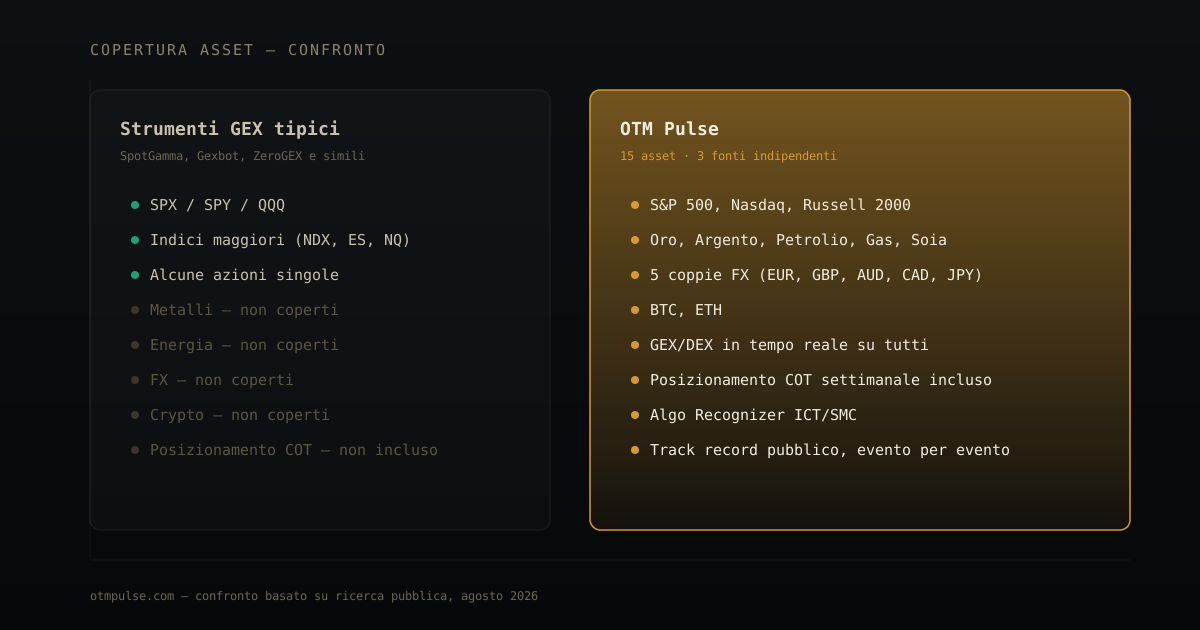
What's consistent across nearly all of them, regardless of category: the ticker universe stops at US equities, ETFs, and major indices. A handful mention futures awareness, and it typically means ES and NQ — nothing on metals, energy, agricultural futures, or FX.
Where OTM Pulse Fits
OTM Pulse isn't trying to out-SPX SpotGamma, and it isn't a cheaper clone of any single tool above. It sits in a gap that showed up consistently while researching this space: none of the platforms covering CME futures, FX, and crypto alongside equities also combine that GEX/DEX profile with CFTC institutional positioning data.
The GEX/DEX engine covers Gold, Silver, Crude Oil, Natural Gas, Soybeans, S&P 500, Nasdaq, Russell 2000, five FX pairs, and BTC/ETH — computed continuously, not just at the open. The Confluence Engine layers weekly COT data and algorithmic ICT/SMC pattern recognition on top of that GEX/DEX read, so a directional read comes from three independent sources instead of variations on the same options chain — the same COT-positioning context covered in our guide to insider buying signals, brought into the same structural picture as GEX.
The other piece worth naming directly: a public, per-event track record. Not a single aggregate win-rate number, but every signal individually inspectable — real percentage change, Maximum Favorable and Adverse Excursion (MFE/MAE) computed on intrabar highs and lows, and an interactive backtest explorable by asset. It's the kind of transparency that's rare enough in this space to be a genuine differentiator rather than a marketing line.
See it instead of reading about it
The public track record is live and updates automatically as new signals resolve — no account needed to look.
View the public track record · Start with OTM Pulse
Sources and further reading
Comparative research on gamma-exposure and options-analytics platforms, drawing on public pricing and feature pages as of August 2026, including coverage from Group Buy Trading, Gamma Sonar, FlashAlpha, and Options Trading Toolbox.