
Insider buying signals are a genuine, tradable edge — but only when you filter out the noise first. Open-market purchases filed on SEC Form 4 by C-suite executives, especially when multiple insiders buy within the same compressed window, have been associated with statistically significant abnormal returns in peer-reviewed research. The catch: most Form 4 volume is compensation mechanics, not conviction, and liquidity constraints can erase the edge before you capture it.
Here is what the evidence supports and what it does not:
- High-conviction signals: open-market "P" code purchases by CEOs, CFOs, or directors, particularly when clustered across multiple insiders within 14–30 days.
- Weak or neutral signals: option exercises, RSU vesting, tax-withhold sales, and scheduled 10b5-1 plan purchases.
- Key limits: small-cap insider buys may be illiquid at any meaningful size; the market often partially prices the signal within days of the filing.
The rest of this guide covers the taxonomy, a scoring rubric, and the workflow to turn raw filings into a backtestable trade checklist.
Key Takeaways
Filtered, open-market insider purchases by C-suite executives — especially when clustered across multiple insiders within 30 days — represent one of the most empirically supported edges available to systematic traders, but only when paired with liquidity checks, regime filters, and pre-defined exit rules.
| Point | Details |
|---|---|
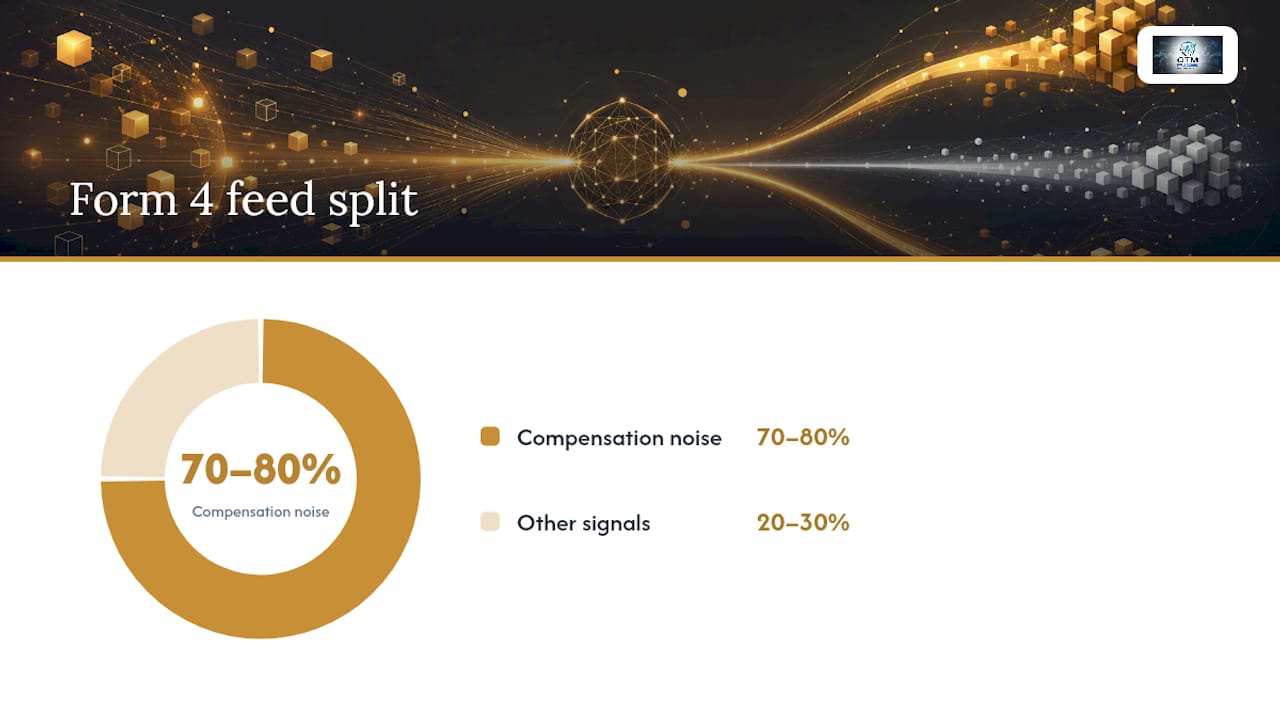
| Filter before you score | Roughly 70–80% of Form 4 volume is compensation-driven; only P-code open-market purchases qualify as high-conviction signals. |
| Cluster buys outperform | Multiple insiders buying within a 30-day window produce materially stronger abnormal returns than isolated single purchases. |
| Liquidity caps position size | Small-cap insider signals often cannot scale beyond modest position sizes without slippage eroding the edge. |
| Layer regime signals | Combining insider scores with GEX/DEX regime context improves entry timing and reduces exposure during high-slippage environments. |
| OTM Pulse operationalizes the workflow | OTM Pulse pairs GEX/DEX overlays with watchlists and alerts, connecting insider scoring to market-regime context in one place. |
- What counts as an insider buying signal
- What the research shows
- A practical decoder
- From data to trade: workflow and rubric
- False positives and red flags
- Layering market-structure inputs
- Risks and legal considerations
- Why insiders are a signal layer, not a strategy
- How OTM Pulse fits into this workflow
What counts as an insider buying signal
The formal term for what traders call an "insider buying signal" is a Section 16 beneficial ownership change, reported via SEC Form 4 within two business days of the transaction. That short window is what makes Form 4 data fast enough to trade on — filings are public through SEC EDGAR the moment they're accepted.
Transaction codes and what they actually mean
Not every Form 4 filing is a signal. The transaction code in Column 3 tells you almost everything about whether a purchase reflects genuine conviction or routine compensation.
| Code | Type | Interpretation | Weight |
|---|---|---|---|
| P | Open-market purchase | Insider spent personal cash | High |
| A | Grant / award | Compensation | Low |
| M | Option exercise | Converting options to shares | Low–moderate |
| F | Tax withholding | Often a net sell | Low |
| G | Gift | Transfer, not a market view | None |
| S | Open-market sale | Insider sold | Bearish context |
Open-market "P" purchases are the gold standard because the insider is writing a personal check. Awards, exercises, and withholding are compensation mechanics — they describe the pay structure, not the insider's view of the stock.
Who counts as an insider, and why role matters
- CEO and CFO: highest weight — the broadest view of operations, pipeline, and financial condition.
- Other C-suite (COO, CTO, General Counsel): high weight, especially outside a compensation cycle.
- Board directors: moderate weight — governance visibility, less operational detail.
- 10% shareholders: context-dependent — an activist buying more differs from a passive fund rebalancing.
Quick filtering rules to apply before anything else:
- Exclude any transaction coded A, F, G, or M from the high-conviction list.
- Exclude purchases under $10,000 as likely token buys.
- Exclude any buy that changes ownership by less than 0.1%.
- Flag, but don't auto-include, purchases made under a disclosed 10b5-1 plan.
What the research shows: returns, speed, liquidity, and scalability
The academic case for insider buying as a predictive signal is solid, though narrower than the headlines suggest. Seminal work by Seyhun (1986) and Lakonishok and Lee (2001) established that insiders — particularly corporate officers buying on the open market — earn positive abnormal returns relative to the market over 6–12 month horizons. Jeng, Metrick, and Zeckhauser extended this line of research and found purchase portfolios outperform sale portfolios by a meaningful margin, with the edge concentrated in smaller, less-covered stocks.
More recently, peer-reviewed analysis in Finance Research Letters confirms that properly filtered Form 4 signals — screened for transaction code, insider role, and cluster patterns — produce statistically significant abnormal returns. Effect sizes are sensitive to how a cluster is defined and which holding horizon is used: a 30-day cluster window with a 12-month hold behaves very differently from a 7-day window with a 1-month hold.
Cluster buying deserves its own emphasis. When multiple insiders buy within a compressed window, the signal is materially stronger than any single purchase. One executive buying could reflect personal financial planning; three executives buying within two weeks is harder to explain away.
The practical limits traders underestimate
Roughly 70–80% of Form 4 volume is compensation-driven, so raw filing feeds are mostly noise.
Speed matters too: the market partially prices Form 4 signals within the first 1–3 days after filing. Traders acting on day 3 or later capture less of the move than those with real-time alerts — this isn't a strategy for a weekly review cadence.
Contrarian insider buying adds another layer. Insiders who buy after analyst downgrades signal internal disagreement with market consensus — a setup that has historically preceded outperformance, and one of the more interesting sub-filters to backtest.
A practical decoder: which buys to weight more, and why
Not all "P" code purchases are equal. Priority ranking once you've cleared the basic filters:
- Transaction code first: P-code only — everything else is excluded or flagged for review.
- Insider role second: CEO/CFO buys carry the most weight; director buys are meaningful but secondary.
- Dollar amount and ownership change third: a $500,000 buy by a CEO who already owns 2% differs from a $50,000 buy by a director with minimal prior holdings.
- First-time buyer vs. repeat buyer: a CEO buying for the first time in three years is stronger than one who buys small amounts every quarter as a habit.
- Cluster confirmation last: a single buy is a watch-list candidate; two or more insiders within 30 days is a higher-conviction setup.
Cluster definitions in practice
A 14-day window is tight and catches only the sharpest coordinated conviction. A 30-day window is the practitioner standard, balancing sensitivity against false-positive risk. A 60-day window captures broader organizational sentiment but dilutes the timing signal. Start at 30 days and test the others in your backtest.
Low-confidence events to deweight
Purchases under a pre-disclosed 10b5-1 plan are scheduled in advance and carry no real-time informational content. Token purchases under $10,000 often reflect a board ownership requirement rather than a market view. Buys that follow heavy insider selling in the prior 90 days deserve extra scrutiny — the net signal may be negative even if the most recent transaction is a buy.
From data to trade: a step-by-step workflow and scoring rubric
A structured workflow is what separates traders who profit from insider signals from those who chase headlines.
- Ingest Form 4 data in real time via SEC EDGAR direct feed, a commercial API, or a tracker such as InsiderFinance or Barchart's insider activity module.
- Apply hard filters: keep only P-code transactions; exclude A, F, G, M codes; exclude purchases under $10,000; exclude 10b5-1 plan transactions.
- Score each filing using the rubric below.
- Check for cluster confirmation: has another insider at the same company filed a P-code buy within the past 30 days?
- Add to watchlist if the score exceeds your threshold (suggested: 6 out of 10 minimum).
- Assess liquidity: can you enter and exit your intended size without moving the stock more than 0.5%? If not, reduce size or skip.
- Define entry rules: enter within 1–3 days of filing to capture the bulk of the signal premium.
- Set holding window and exit rules before entering — 1, 3, or 12 months, with a stop-loss at 8–12% below entry.
Scoring rubric
| Factor | Scoring criteria | Max |
|---|---|---|
| Transaction code | P-code = 3; all others = 0 | 3 |
| Insider role | CEO/CFO = 3; other officer = 2; director = 1; 10% owner = 1 | 3 |
| Dollar size (normalized) | >5% of known holdings = 2; 1–5% = 1; <1% = 0 | 2 |
| Cluster multiplier | 2+ insiders in 30 days = +2; single buy = 0 | 2 |
| Recency | Filed within 2 days of transaction = 1; older = 0 | 1 |
A score of 7 or above is a strong candidate. Scores of 5–6 go on a watch list pending cluster confirmation.
Backtesting parameters
Test holding windows of 1, 3, and 12 months separately — they behave differently. Require a minimum of 50 qualifying signals per backtest period before drawing conclusions; smaller samples overfit easily.
False positives and red flags
The biggest mistake traders make with insider activity is treating any Form 4 filing as a signal. Most are not.
- 10b5-1 scheduled purchases: pre-planned, no real-time informational content.
- Option exercises (M code): often driven by expiration dates or tax planning, not a view on the stock.
- RSU vesting (A followed by F): the award is compensation, the withholding is a tax transaction — neither reflects a market view.
- Token purchases under $10,000: often a board minimum-ownership compliance buy.
- Purchases following heavy insider selling: if three insiders sold in the past 60 days and one buys a small amount, the net signal is bearish.
- Buys changing ownership by less than 0.1%: too small to reflect genuine conviction.
- Purchases around pending M&A or restructuring: context matters — the buy may reflect information about to become public, which raises legal questions rather than trading opportunities.
Behavioral pitfalls to watch
Confirmation bias is the most common trap — once you like a stock, you'll find insider buys that confirm your thesis and discount the ones that don't. Run your filter rules before you look at the company, not after. Survivorship bias distorts backtests if you only study insider buys in companies that later performed well. And overfitting to short backtests is endemic: a 12-month backtest with 15 signals proves almost nothing — require at least 3–5 years of data and 50-plus signals before trusting a parameter set.
How to improve signal quality by layering market-structure inputs
Insider conviction tells you what to buy. Market-structure indicators tell you when to buy it and how much risk you're taking on at entry.
Gamma Exposure (GEX) and Delta Exposure (DEX) measure the structural positioning of options dealers. When GEX is positive and stabilizing, dealers are long gamma and tend to dampen volatility — a more favorable environment for directional trades. When GEX is deeply negative, dealer hedging amplifies moves in both directions, raising slippage risk and making entry timing harder.

A practical integration rule: treat an insider buy signal as a candidate, then check the market-regime context before sizing the position. If implied volatility is spiking and GEX is deeply negative, even a high-scoring insider signal may be better held on a watch list until the regime stabilizes — the insider's conviction doesn't expire in 48 hours, so entry timing can afford to wait a few days for a cleaner setup.
Risks, legal considerations, and disclaimers
Trading on Form 4 filings is legal. Trading on material non-public information (MNPI) is not. The distinction matters: Form 4 data is public the moment it's filed with the SEC — you're analyzing disclosed transactions, not acting on tips.
Research limitations are real. Historical abnormal returns from academic studies are sample-based, often concentrated in specific market regimes, and may not persist as more capital chases the same signals. Capacity constraints, liquidity limits, and partial market pricing of Form 4 data all compress the live edge relative to backtested results. Slippage, taxes on short-term gains, and margin requirements can also materially change net outcomes, particularly at higher trading frequency or in less liquid names.
This article is for informational purposes only and does not constitute investment advice. Consult a qualified financial professional before making trading decisions.
Why insiders are a signal layer, not a strategy on their own
The evidence for insider buying as a predictive signal is genuine, but traders who treat it as a standalone system tend to underperform those who treat it as one layer in a broader framework:
- Filter ruthlessly before you score. The 70–80% compensation-driven noise in raw Form 4 feeds means your filter rules do most of the work.
- Cluster confirmation is the single most reliable upgrade. A solo P-code buy by a CFO is interesting; three insiders buying within 30 days is a different category of signal.
- Regime context determines timing and sizing. GEX/DEX overlays give a structured way to assess whether the market environment supports a directional position when the insider signal fires, rather than entering blind into a high-volatility, high-slippage regime.
The traders who get the most from insider signals are the ones who've already decided their position-sizing rules, holding windows, and stop-loss levels before the alert arrives. The signal is only as good as the pre-wired play behind it.
OTM Pulse fits directly into this workflow
Tracking real-time Form 4 filings, scoring them against a rubric, checking the market regime, and managing a watchlist is a lot to coordinate manually. OTM Pulse pairs the market-structure layer — GEX and DEX regime signals — with watchlist management and real-time alerts, so the insider signal and the regime context arrive together instead of requiring separate lookups.

A trader using OTM Pulse could set a watchlist trigger for any stock reaching a scoring threshold of 7-plus on the insider rubric, then overlay the GEX regime indicator to confirm whether current market structure supports a directional entry. The platform's trade journal logs the entry rationale, the regime context at entry, and the outcome — exactly the data needed to calibrate a scoring rubric over time. The DEX matrix adds a delta-skew layer that helps size positions relative to current options-market pressure, not just historical volatility.
Connect insider signals to market regime
Run this workflow without building it from scratch — OTM Pulse pairs GEX/DEX regime context with your watchlist from day one.
Start with OTM PulsePrimary sources and further reading
- SEC Forms 3, 4, and 5 documentation — the authoritative source for transaction code definitions, filing windows, and who qualifies as an insider.
- Finance Research Letters DOI study — peer-reviewed analysis of filtered Form 4 signals and abnormal returns.
- 13F Insight: How to spot insider buying signals — practitioner breakdown of transaction codes and filtering logic.
- AlphaScala: How to track insider buying — workflow-focused guide from filing ingestion to watchlist management.
- Insideraction — cluster definitions, scoring systems, and the academic evidence base.